Save 30% on Costs A Complete Breakdown of the 5 Axis CNC Machining Process for High-Precision Parts
Introduction
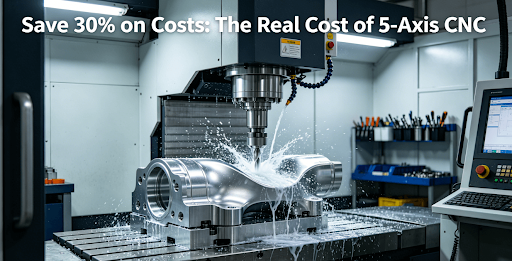
In aerospace, medical device, and high-end consumer electronics manufacturing, sourcing complex, high-precision metal parts often presents a dilemma. Traditional 3-axis machining struggles to meet geometric demands with low yield, while transitioning to 5-axis CNC can be daunting due to perceived high initial costs and complex process choices.
The root cause is that many decision-makers focus solely on the upfront CNC 5 axis price, overlooking the total cost of ownership (TCO) from process inefficiencies—repeated setup errors, material waste, and delivery delays. Additionally,blur understanding of 3+2 positional versus simultaneous 5-axis applications leads to resource misallocation.
This article provides an evaluation framework beyond simple price comparison, deconstructing the real cost of 5-axis CNC, clarifying key process choices, exploring material and design synergy, and outlining a path to high volume CNC machining.To make an informed procurement decision, first, common misconceptions about 5-axis machining costs must be addressed.
Why Focusing Solely on Hourly Rate Can Lead to Overspending on 5-Axis CNC Machining?
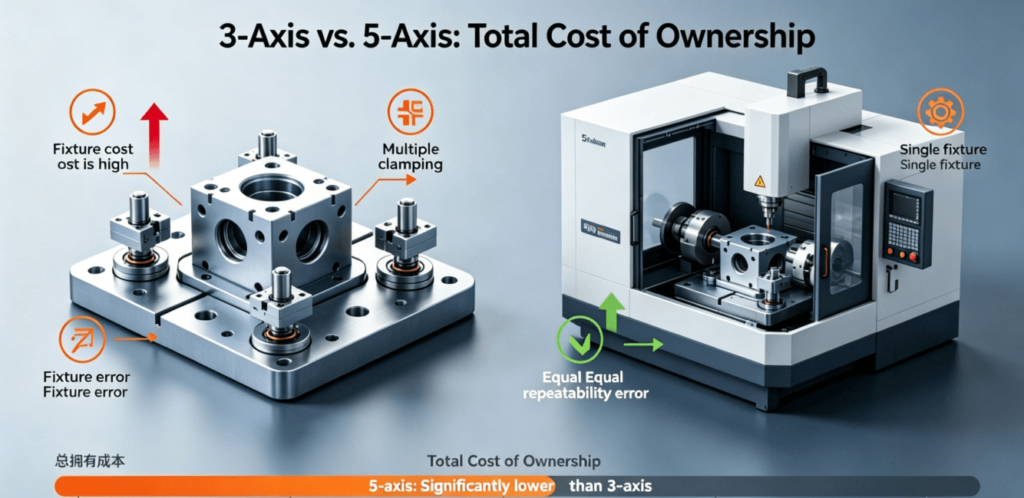
Evaluating 5 Axis CNC Machining Services based only on per-hour rate is a costly oversight. True economy is assessed through total cost of ownership (TCO).
The Cost Structure Behind the Rate
The surface “hourly rate” consolidates costs from machine depreciation, advanced programming, material, and post-processing. Investment in a high-end 5 axis vertical machining center and its ecosystem is reflected here, but this is just one component.
TCO Analysis: 3-Axis Multi-Setup vs. 5-Axis Single Setup
A complete view requires comparing the full cost chain of 3-axis multi-operation versus 5-axis integrated approaches.
- Total Hours and Scrap Rate
Complex parts on 3-axis machines need multiple fixtures and setups, each introducing error, increasing total hours, and lowering yield. 5-axis machining completes multiple sides in one setup, eliminating these errors at the source, drastically reducing scrap. A higher hourly rate can be offset by significantly lower total hours and waste.
- Fixturing and Overhead Costs
Each new orientation in 3-axis machining requires dedicated fixture design and cost. 5-axis machining uses universal workholding, changing angles via machine rotation, simplifying tooling and reducing associated overhead and inventory.
Case Study: Higher Rate, Lower Final Cost
Consider a bracket with multiple angled features. A 3-axis plan requires 4 setups, 3 custom fixtures, 85% yield, 3-week lead time. A 5-axis plan uses one setup, no custom fixtures, 99% yield, 1-week lead time. Despite a higher hourly CNC 5 axis price, the 5-axis solution’s TCO is 20% lower due to yield, material, and time savings. For a detailed breakdown, read this An In-Depth Analysis of 5-Axis CNC Machining Service Pricing.
3+2 Positional vs. Simultaneous 5-Axis: Choosing Based on Part Geometry
Selecting the right mode is crucial for optimizing 5 axis CNC parts. It’s a strategic match between process and geometry.3+2 positional machining locks the rotary axes, then cuts in 3-axis mode. It excels in rigidity, speed, and lower programming cost. It’s ideal for multi-faceted parts like enclosures or parts with discrete angled features (e.g., tilted holes). Using a 5 axis vertical machining center in 3+2 mode is highly efficient for such components.
Simultaneous 5-axis machining moves all five axes continuously during cutting. It is essential for continuous complex surfaces like impellers, implants, or aerodynamic forms, offering unmatched finish and accuracy for organic shapes.Selection is direct: For parts with distinct, fixed-angle faces, 3+2 is optimal for efficiency and cost. For fluid, complex contours, simultaneous 5-axis is necessary for precision. Expert Precision Manufacturing Solutions providers analyze geometry to recommend the correct strategy.
Material and Design Optimization: Controlling Cost and Performance at the Source
For custom machined parts, effective cost control begins in the design phase, where material selection and geometric design directly dictate machining difficulty, time, and final expense. The choice of material has a major effect on the machinability of any workpiece; whereas aluminum would be perfect for 5 axis CNC milling as it is easy to machine, materials such as stainless steel and titanium pose a difficult task for 5 axis vertical machining centers, leading to increased wear and tear of the tools as well as increasing the cycle times. However, the greatest source of expense lies in Design for Manufacturing (DFM); implementing a few key tenets of DFM can greatly decrease the difficulty of programming, the risks involved in machining, and costs..
From Prototype to Volume: Ensuring Consistency in 5-Axis CNC Quality
Reliable Precision Manufacturing Solutions rely on a strong quality control system to ensure the first article and volume productions are consistent with each other. quality control begins with the initial product inspection. Critical 5 axis CNC parts go through a complete dimensional check using a CMM. During production, Statistical Process Control (SPC) tracks the vital dimensions, facilitating timely alterations. The success of this system depends on standardized and traceable processes.
Suppliers that are certified to ISO 9001, IATF 16949, or AS9100D carry out such procedures, making certain that each part, whether a prototype or produced through high volume CNC machining, is made by the same controlled process, thus stable quality is assured. Working with a certified supplier is the key to consistency.
How to Evaluate a Supplier’s Reliable Volume Production and Collaboration Capability?
Scaling to high volume CNC machining requires evaluating a supplier as a collaborative partner, not just a machine shop. Superior CNC Machining Services providers act as extensions of your team.
Engineering Support: From DFM to Continuous Improvement
The best partners provide deep, proactive DFM feedback, not just quotes. During production, they should offer process optimizations to enhance efficiency and reduce cost.
Production System: Transparency and Predictability
Stable volume requires reliable capacity planning and transparent scheduling. Assess a supplier’s order tracking, communication protocols, and contingency planning for delays.
Supply Chain and Responsiveness
A resilient supply chain is critical for high volume CNC machining stability.
- Raw Material Security
Reliable partners maintain safety stock or have strong distributor relationships for key materials, mitigating supply chain risks and price volatility.
- Change Management
Design changes are inevitable. An excellent partner evaluates impact swiftly, provides clear revised costs/timelines, and adapts production schedules flexibly to minimize disruption.Choosing such a partner ensures a smooth transition to stable volume production. For a systematic vetting framework, see: How to Choose a Cost-Effective 5-Axis CNC Machining Service Provider.
Conclusion
The decision to choose 5 axis CNC machine services entails a delicate balance of value, precision, and relationship. Real value comes from process fit, system stability, and partnership—rather than just a quote. By taking a total cost of ownership approach, being aware of technical choices, and partnering with the right company, businesses can turn high-end machining into a competitive edge.
If you seek a reliable, economical 5-axis solution for complex metal parts, consult a professional provider certified to ISO 9001, IATF 16949, or AS9100D. Upload your drawings for a quote with detailed DFM analysis and transparent cost breakdown to start optimizing cost and performance.
Author Bio
This article was contributed by an expert with over 15 years in precision manufacturing, specializing in advanced CNC applications and supply chain optimization. His insights are drawn from global collaborations with leading equipment makers. He is part of JS Precision—a leading custom manufacturer holding ISO 9001, IATF 16949, AS9100D, and ISO 14001 certifications.
FAQs
Q1: What is the MOQ for 5-axis CNC Machining?
A: It depends on the machine model used by suppliers. Professional companies usually provide services for various order quantities, from single-piece prototyping to mass production, without large minimum quantities required.
Q2: Can the machining accuracy be improved significantly with 5-axis machining when compared to 3-axis machining?
A: The machining accuracy may increase due to the avoidance of multiple setups, improving the machining accuracy by one grade level, where the feature tolerances can be guaranteed to ±0.01mm to ±0.025mm, depending on the parts.
Q3: Is it necessary to have my part manufactured using 5-axis machining?
A: Yes, if your part design includes deep cavities, multi-angle, and complex surfaces that require multiple setups on 3-axis machines.
Q4: How is my design documentation kept confidential?
A: Choose a supplier that has a rigorous non-disclosure agreement process, secure file hosting, and controlled access. Most internationally accredited businesses will follow an established information security procedure.
Q5: What is the standard turnaround time for quote to first sample?
A: If you want first samples of average complexity in aluminum products, your qualified supplier should give you the product within 1-2 weeks after receiving all the necessary documentation.