For Hardware Startups: How to Slash 30% Off Your CNC Machining Budget Through Smart Small-Batch Planning
Introduction
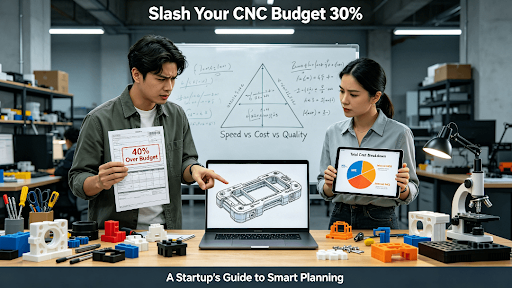
Hardware startups and new product development companies can face a harsh reality of “budget shock,” which is when they shift from prototyping a product to running a pilot run batch of the first hundred to five hundred units. The cost per piece can be much greater than anticipated when compared to prototyping, sometimes even several times higher than what was expected. Budgets suffer and difficult trade-offs regarding quality, functionality, and/or marketing have to be made, compromising the future success of the product.
The problem lies in using one of two mindsets when dealing with the specifics of small batch manufacturing – either a “prototype mindset” that fails to consider the true cost of creating a standard process and achieving high levels of quality or a “mass-production mindset” that does not take into consideration the limitations of economies of scale during small batches. This article offers a “Small-Batch CNC Cost Optimization and Risk Management Framework” that allows one to change perspectives and concentrate on three critical levers of successful manufacturing.
Why Does Small-Batch CNC’s Per-Piece Cost Appear So High?
The surprisingly high per-piece cost in small-batch manufacturing can be understood through the law of fixed-cost domination. Costs of non-recurring activities such as computer-aided manufacturing programming, designing fixtures, inspecting initial parts, and buying minimum stock material all add up significantly. The impact of allocating such fixed costs over a very small quantity of parts such as 50 or 100, rather than 10,000, creates an inflated per-piece cost. Recognizing this cost behavior is the first step towards understanding the optimization process. As per MIT OpenCourseWare manufacturing economics, fixed costs dominate low-volume production, which inherently creates the economic model of small batch manufacturing. In order to optimize the fixed costs systematically, there exists an excellent book on the topic.
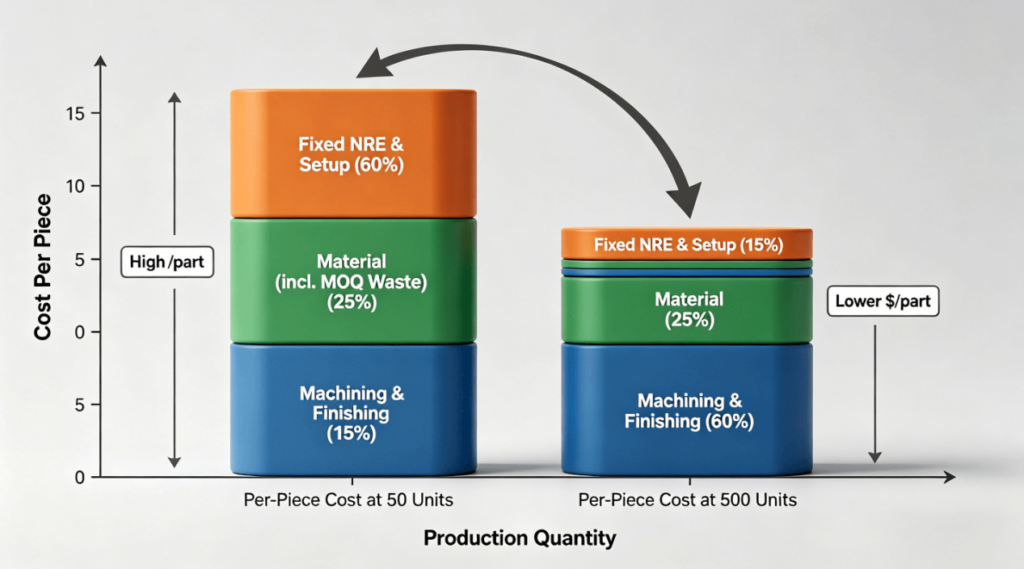
- The Burden of Non-Recurring Engineering (NRE): In a single order of 20 pieces, the effort required to program the part on the CAD/CAM system, develop a machining process, and design the workholding fixture is similar to the run-time of the part itself. These costs are sunk, and the company will have to recover them through your order. While negligible when making in large quantities, NRE is one of the main driving factors for small quantities. If the supplier has standardized and modular tooling, along with good programming processes, they can minimize this cost.
- Material Costs: The Minimum Buy Issue: Material prices are often not proportionate. This could imply that, to produce those 30 bracket pieces, the manufacturer might be required to buy a whole 12-feet aluminum bar at its original price, even though the job would only consume a part of that bar. Some materials or types can only be bought with a minimum order from their suppliers, which will mean that more material will need to be purchased than what your job requires.
- Quality Validation: The Cost of Certainty: With small batches, you can’t perform statistics-based sampling. You achieve assurance in quality through 100% validation of the first article along with strict process control, which requires a thorough FAI using a Coordinate Measuring Machine, a highly labor-intensive and skill-dependent procedure. And the price tag for obtaining an inspection report, confirming the correctness of the process by facts, becomes another unavoidable and non-negotiable component of the total cost because you will need functional parts in addition to manufactured parts.To gain a deep understanding of systematic approaches to optimizing these fixed costs, a comprehensive guide on small-batch CNC machining offers a complete perspective — ranging from design to supplier collaboration.
How to Balance the “Speed-Cost-Quality” Triangle in Your Small-Batch Project?
There’s no denying that each small batch manufacturing project requires trade-offs among Speed, Cost, and Quality. But in what order do you prioritize these components? It’s crucial to choose your main criterion for making decisions in each particular stage of your project. The definition of your priority gives a clear structure to the process and helps avoid hasty decisions. If you’re dealing with an absolute priority on speed (as in the case of crowdfunding delivery, for example), you have no problem spending more money. But when it comes to minimizing the cost, you need order consolidation and proper material choice.
1. The “Speed First” Scenario: A Costly Time Rush
Time to market is paramount, meaning that cost considerations and some quality considerations will be sacrificed. This entails being willing to pay a premium for an urgent scheduling of machines, opting for an expensive yet fast machinable material or foregoing the need for non-essential finishing. The emphasis here is on time management through the selection of a proven supplier capable of on-demand production and possessing excess production capacity to ensure timely delivery, albeit with added cost considerations.
2. The “Cost First” Scenario: Smart Frugality
With money becoming the constraining factor, the lead time increases, and product design considerations might be pared down. In such a case, there would be the need to consolidate different part designs into a single production run to share the cost of machine set up, use of a cheaper grade of material and relaxing of the non-critical tolerances on the part drawing. This would require extensive preparation and coordination with potential suppliers to find cost-saving measures for the part.
3. “Quality/Performance First” Scenario: Mitigating Risks in the Product
Where there cannot be any failures, product quality and its performance must be the priority. For this, there is an investment required into better materials, advanced and thus expensive machining, along with thorough product inspection. Here, speed and cost take a second place behind certification of materials used, manufacturing process validation, and inspections. Such measures eliminate all technical risks, which will provide for safe scaling up.
What Design Decisions Will Affect Cost and Time of Small Batch Manufacturing the Most?
In terms of small batches, DFM decisions are crucial when it comes to their cost and lead times. If a design is easy to manufacture with the use of 3-axis equipment, it will be much more economical compared to a design, which would require complicated 5-axis machining. Use of micro-tools in designs leads to greater cost and complexity. DFM decisions make up all factors influencing machining time, waste generation, and success rate.
- Complexity is the Cost Killer: The perfect design with organically shaped surfaces looks amazing but will always need 5-axis simultaneous machining at significantly higher hourly rates. Small deep pockets with tiny radiuses will need extra-long and fragile cutting tools that will cut much slower, thus raising cycle time dramatically. Making geometry simpler and suitable for machining by standard tools within fewer set-ups is an excellent strategy to lower the cost. Questioning whether some complex detail is required at all from a functional point of view may save you thousands.
- Pricey Micro Details and Over-tolerancing: Calling out for 0.5 mm diameter holes or tolerances up to ±0.025 mm on non-critical dimensions will kill your budget. Micromachining requires costly special tooling. Tight tolerances lead to slower machining, additional tool changes, and full inspection cycles. Using GD&T correctly to provide tighter tolerances only to mating and/or functionally critical details while applying normal machining tolerances in other areas, will help you to save machining costs without sacrificing the quality of custom machining.
- Designing to Use Standard Stock and Optimize Machining Efficiency: The design for uniform thickness eliminates the risk of inefficient machining. The ability to machine components from the stock bar or plate ensures material costs savings. In addition, the use of chamfers will reduce the time spent on de-burring. All of the above-mentioned “design for cost” considerations, although ignored at the prototype stage, can play a significant role during small-batch manufacturing as important financial factors. Consulting with the manufacturer during a DFM analysis can reveal such opportunities.
How to Evaluate a CNC Machining Estimate: Differentiating Worth from Vague Claims?
The proper CNC estimate is a project plan, not just the total price. A professional estimate provides information about the cost structure of the component (materials, programming, machining, and finishing). Even more, it should indicate potential issues that may arise during machining and suggest ways to optimize the design. The estimate gives the opportunity to conduct an “apple to apple” comparison between the estimates and determine the engineering skills of the CNC service provider.
1. The Structure of a Transparent Quote
The informative quote contains information about costs for materials (taking into account waste factor), programming and setting up (NRE), hour cost for machining and processing after CNC machining services have been completed. Such a quote indicates any surcharges due to high-risk factors such as: “Additional charge of $XXX for custom extended-reach tooling necessary for deep cavity X.” This approach helps create the design for cost mentality by making clear the impact of design decisions and builds customer trust in the supplier of CNC machining services.
2. The Quote is a Pre-Risk Assessment
It is highly useful when quotes contain important comments about risk involved: “Deep pocket may necessitate special tooling, thus increasing manufacturing costs and time” and “Recommendation: Increase minimal wall thickness for better stability.” In such a way quotes give you geometric features interpretation in terms of manufacturability risks. You will be able to make appropriate decisions before starting manufacturing in order to avoid possible unexpected expenses later on.
3. Assessment of “Value Add” Above and Beyond the Quote
Search for quotations that talk about their value-added services. Is there any mention of offering a free DFM analysis? Is there a mention of an inspection procedure for key dimensions? Is there a mention of how they communicate about the project internally? Although they do not come with any price tag, these factors will greatly decrease the administrative burden and risks of your project. It is better to pay a little extra when dealing with such suppliers.
From Prototype to Pilot Run: A Case Study on Systematic Small Batch Success
This case study is presented de-identified to show the strength of the framework. An Internet of Things company required 300 batches of enclosures and brackets for their pilot run. The initial quotations were quoted at 40% above the budget. They used the framework, conducting a timely DFM process with a new supplier, integrating parts, improving product design features, and decreasing part count by 15%. They chose a supplier with a digital project dashboard for effective monitoring. They had established quality acceptance criteria. The outcome? Total costs were 10% below the budgeted amount, delivered one week earlier than planned, and first-pass yields were greater than 99%.
1. Problem: Budget Overrun Endangering Launch
Although the startup’s first design concept was aesthetically pleasing, it proved difficult to manufacture effectively. In the first set of quotes obtained from non-specialist machine shops, an enormous budget overrun emerged, which jeopardized the completion of the pilot run and the eventual market introduction of the product. The team was at an impasse, trapped in the small-batch quandary of unfavorable economic conditions, which could prevent their product from gaining momentum in the market.
2. Systemic Solution
The team sourced another manufacturing partner and proceeded with a systematic approach. Predictability of Cost: A mutually agreed fixed-price contract was established with a specified deliverable timeline. Design Optimization: A DFM workshop resulted in component reduction and simplified design to improve manufacturability. Forward Loading of Quality: The manufacturing process had quality control integrated into its process flow, where a digital FAI document had to be reviewed prior to batch manufacturing.
3. The Result: Controlled Process and Market Proof
The process was carried out seamlessly. Not only was the cost of production under control, but there were also gains made with respect to time and quality. Indeed, the startup was able to provide its pilot clients with parts without suffering from an overwhelming financial blow. This case is proof that when the pilot run process is viewed as a project in engineering, as opposed to one purely related to procurement, it can become a solid stepping-stone for CNC machining.
What Defines an Ideal Manufacturer for Small Batch and On-Demand Manufacturing Projects?
An ideal manufacturing company for small batch orders will be characterized more by its systemic capabilities rather than by the types of machines it has in use. The company will have a production system that is flexible and capable of handling high-mix-low-volume order, a workflow system where all tasks are digitally controlled and a quality assurance system that ensures consistent results. For startups looking to get an agile solution, operational capabilities matter more than the types of machines that a supplier might have. Stability of a quality system determines whether one can achieve consistency in the manufacturing process. A manufacturer adhering to the ISO 9001 standard has the necessary systems for managing variability and uncertainties during a small batch project. In essence, the choice of a manufacturing partner involves the choice of an operational system that is agile. An accredited company will ensure consistent delivery of quality custom CNC machining services.
1. Flexibility and Digital Transparency
A true small-batch specialist not only has flexible manufacturing cells and agile scheduling but provides digital transparency via their online portal where you can follow your order, get immediate quotes and drawings, and have digital inspection results. In other words, the process becomes more transparent and collaborative rather than remaining a black box. This business model is crucial for addressing the nature of startup projects and is another sign of an effective on-demand manufacturing partner.
2. A Quality System Designed to Support Low Volume and High Diversity
The company’s quality management system works well in small batches. There are rigorous processes to ensure thorough but quick first article approval, reliable traceability of materials in small batches, and effective documentation processes for single-item projects. They are smart enough to not impose a high volume statistical model on an order consisting of fifty items. Rather, there is process validation and 100% inspection of critical attributes.
3. Proactive Engineering and Strategic Partnership Mentality
In addition to simply fulfilling the order, the best partners engage in proactive engineering partnerships. They provide useful, unsolicited DFM insights to reduce cost and schedule. They are well aware of the challenges involved in launching a startup and can assist in developing a staged production strategy. They consider the partnership in terms of being a strategic alliance to ensure the success of your product. In this way, the partner becomes a vital extension of your team, making them invaluable to your success.
Conclusion
Effective small-batch CNC manufacturing is a far cry from a simple procurement process but rather involves a carefully thought-out engineering and logistics exercise. With a thorough understanding of the distinct cost dynamics of the process, making deliberate trade-offs, conducting comprehensive DFM analysis, and choosing a partner with the right processes and mindset, hardware startups can de-risk one of their most important stages. With this systematic approach, small-batch CNC production can be turned from a typical cost trap into a reliable growth engine.
FAQs
Q: What are common minimum order quantities (MOQs) for CNC machining of small batches?
A: MOQs depend, but small batch experts typically work on batches of 1-10 units for prototypes and 50-100 for productions. What’s important is low NRE cost. Good small batch experts are able to optimize their programming and preparation, which allows them to process any low batch orders effectively.
Q: How can I decrease the cost of CNC machined small batches of my parts?
A: The best way to reduce the costs of machined parts is to redesign them: in everything make your part as simple as possible, only use standard materials and tolerances when absolutely necessary. You can also save a lot of cash by placing bigger orders. Nonetheless, the ideal option is to talk over DFM concerns with your supplier before all the rest.
Q: How is the quality assured in small batch orders that cannot be sampled statistically?
A: Quality assurance happens through 100% inspection of first articles and process control. One should request a detailed First Article Inspection report with CMM measurements from a reliable provider. Here the emphasis moves away from statistical sampling to the capability and repeatability of the process.
Q: Which file type guarantees fast and accurate quotation in CNC for a small batch?
A: One should upload the complete 3D CAD model in a neutral and solid file format, such as STEP (“.stp”). Add a 2D PDF file showing all critical measurements, tolerances, materials used, and surface finish. Such files allow for prompt and accurate quoting through automation, which means a high-quality provider.
Q: Is it always advantageous to find a local machine shop for small batch work?
A: Not always. Reliable CNC manufacturing websites usually offer more transparency, unique capabilities, and standard digital workflows (DFM, etc.). In addition, a good online CNC machining website can offer a more consistent and precise product in the case of complicated parts through digital inspections.
Author Bio
The writer has been employed as an operations specialist for over a decade. Their work primarily entails helping product companies that make hardware, especially the ones with innovative solutions, to build supply chains which are not only effective and efficient but are also able to take products from the prototype stage to mass production. By partnering with LS Manufacturing, a company that excels in handling challenging and low-volume production projects, the author is able to utilize their expertise and skills. Your CAD files may be shared if you require expert guidance on the manufacturability of your product design which is intended to be produced in small quantities.